
How it works
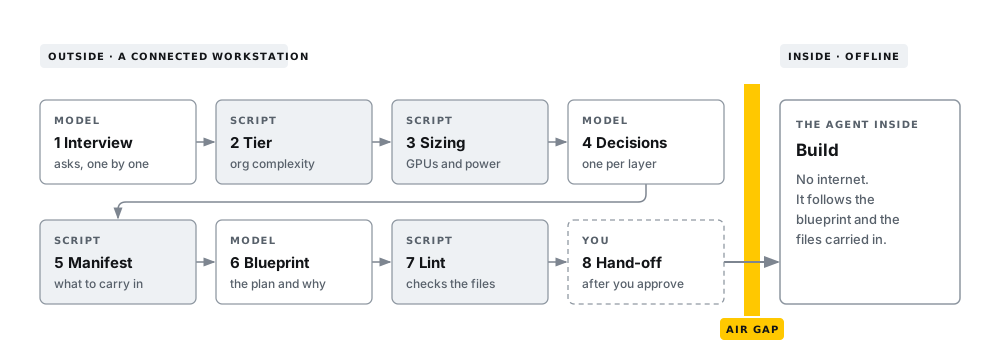
The design is made outside the air-gapped network, on a machine with internet access. The files it produces cross the gap together with everything they list, and an agent inside builds the system from them.
| # | Step | Who |
|---|---|---|
| 1 | Interview: people, departments, privacy, hardware, operations | the agent, one question at a time |
| 2 | Tier and per-layer floors | tier.py |
| 3 | GPU, server and power sizing | size.py |
| 4 | One decision per layer, from decision tables and the catalog | the agent |
| 5 | Transfer manifest | manifest.py |
| 6 | Blueprint, and the agent block in AGENTS.md |
the agent |
| 7 | Consistency check | lint.py |
| 8 | Your approval, then hand-off to an implementation plan | you |
The model judges, the scripts compute
Section titled “The model judges, the scripts compute”The agent weighs trade-offs: which gateway fits four departments with an audit duty, whether a small team should run Kubernetes. Arithmetic and checking are left to four scripts that use only the Python standard library. Every component, version and number in a blueprint comes from the catalog or from a script, never from the model’s memory.
Eight layers
Section titled “Eight layers”Every design makes one decision for each layer: llm-serving, llm-gateway, ui, identity, observability, orchestration, state and registry. The inference engine and the gateway are chosen from decision tables; the other six take per-tier defaults. A decision may reuse what you already run, such as an existing directory or registry.
The check before approval
Section titled “The check before approval”lint.py compares the blueprint with the catalog and with a fresh run of the scripts. It catches a component that is not in the catalog, a layer without a rationale, a tier or sizing that no longer matches the answers, and a manifest older than the decisions. Lint codes lists every check.